

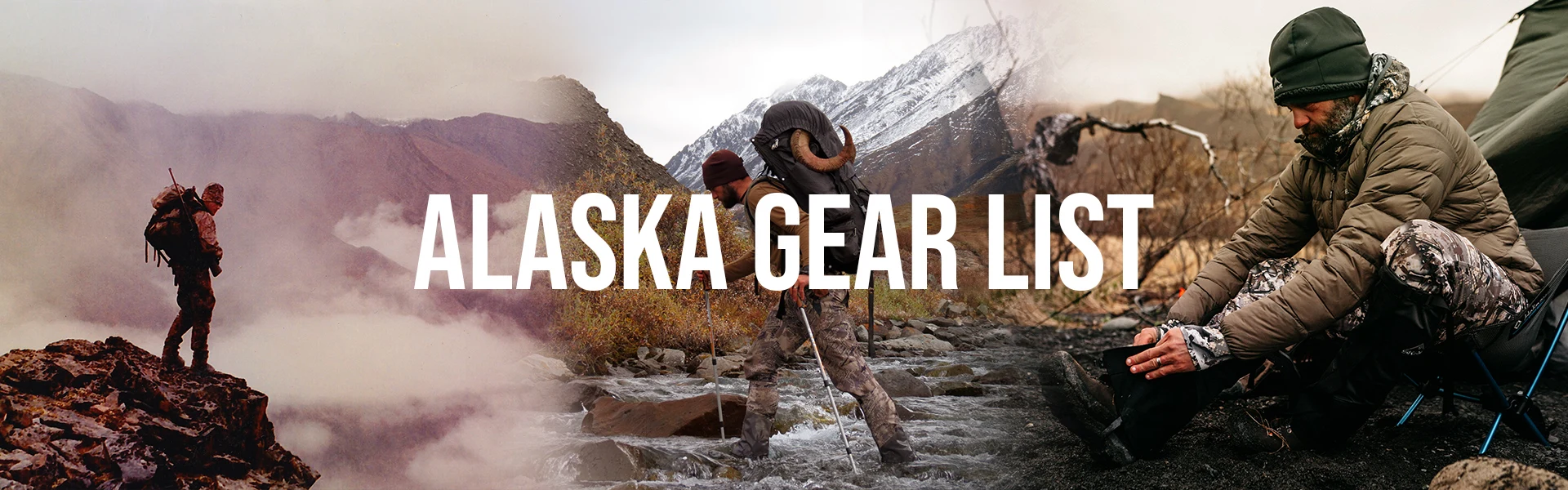
QUALITY GEAR – BATTLE TESTED IN THE MOST CHALLENGING CONDITIONS
BILLY’S PERSONAL ALASKA GEAR LIST
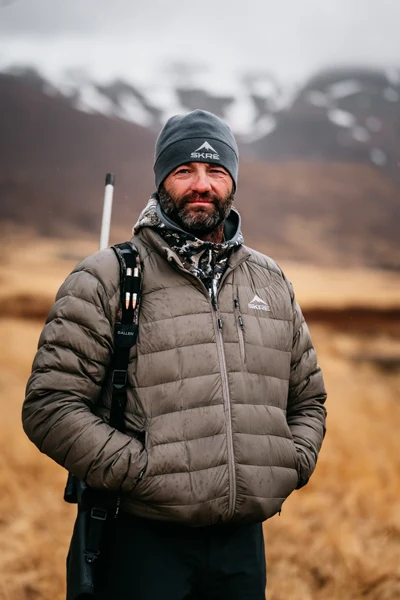 For the past 27 years I’ve guided and hunted in some of the most remote regions of Alaska for brown bear, grizzly bear, Dall sheep, caribou, moose, and wolf. Given the ruggedness of Alaskan hunts and the use of lightweight airplanes, I keep my gear to an absolute minimum. To ensure safety, success, and overall enjoyment I only use top quality dependable gear. Like anything, you typically get what you pay for. If you buy the proper clothing and equipment you don’t need much of it and you will enjoy the use of it for years to come. If you have inferior equipment, sooner or later the Alaskan elements will exploit it, you won’t enjoy your experience, and you could quickly find yourself in serious danger. Trust me: When you experience some real Alaska weather, you will not regret one penny you spent on your gear.
As I general rule I prefer lightweight merino wool against my skin, down for insulation, and durable synthetic materials as outer shells. Having a layering system is key. The following is my personal gear list with links when applicable.
Trust The Guide!


GET 15% OFF EVERY SKRE ORDER WHEN YOU USE PROMO CODE MDMM

GPS/Mapping System- OnX has revolutionized the mapping world! Gone are the days of physical maps and any guesswork of landownership, land access, and terrain features. OnX is a proud sponsor of MDMM and I consider it a must have for all hunters in the US and Canada.
New subscribers receive 20% OFF when USING PROMO CODE MDMM.

Scope/Camera Adapter- Ollin Snapshot system provides the best digi-scoping adapter I’ve ever used. If you’re looking to film your hunt in any capacity, or using a tripod with attachments for any reason, I highly recommend the Snapshot system.
Receive 10% all Ollin products USING PROMO CODE MDMM.
BOOTS
Good boots are essential! Don’t skimp on boots! What works for one person may not work for another. When you find boots that works for you, stick with them. Steeper, rougher terrain requires stiffer, taller, higher quality boots. Meindl, Schnee, Scarpa, Lowa, Kennetrek, Crispi, Zamberlan, and Hanwag are good brands. A good after-market insole is also recommended. I’ve had good luck with “Foot Levelers” custom foot beds. Wet, cold feet are no fun.
When I can, I bring 2 sets of boots. An extra set of insoles is also useful, particularly if you don’t have an extra pair of boots. In my opinion, insulation in boots is overrated; so often it makes your feet sweat more and your boots breathe less. The main thing is to keep your feet dry. If your feet get wet, insulation is a mute point. 0-400 grams of insulation is good for early season and sheep hunts. 400, maybe up to 800 grams is okay for late season and hunts where you’re not as active. I prefer tall boots for Alaska and wet or snowy country. They help keep my feet dry in marshy terrain and creek crossings, and I get less heal slipping, which cuts down on blisters.
MUD BOOTS
LaCrosse knee-high rubber boots can be useful on bear, caribou, and moose hunts. Xtratuf neoprene boots are lightweight and good quality, but don’t offer good traction.
BOOT GAITERS
A quality pair of gaiters is a must on any Alaska hunt. Whether you’re crossing streams, post-holing through snow, or bucking brush, they keep your feet dry and debris out of your boots. I use the Hardscrabble Gaiter Pro from SKRE. BUY NOW
CAMP CHAIR
I highly recommend bringing a packable, collapsible camp chair. My clients and I love the Crazy Creek Camp Chair. I prefer the “Long Back”.
CAMP SHOES
It’s nice to take your boots off when you get back to camp at the end of a long day of hunting. Crocs work well indoors, but not in Alaska’s rain and snow. I like Merrell slip-on shoes or XtraTuf ankle boots.
LIGHT FLEECE JACKET / HOODIE
A Grid Lite Jacket, a Sawtooth Jacket, or the combination of the two is a must have. You’re likely to wear one of these every day of your hunt. Both are polyester/fleece, lightweight, durable, great for layering, or a shell in moderate weather. The Grid Lite is a medium weight. The Sawtooth is heavier with a sherpa fleece inner lining.
Grid Light: BUY NOW
Sawtooth: BUY NOW
GLOVES
I typically bring 2-3 pairs of gloves per hunt. I bring a pair of cheap, lightweight cotton “roper” gloves for work around camp. For hunting, SKRE makes 3 excellent gloves: 1 light, 1 medium, 1 heavy.
Velocity Gloves are a perfect lightweight, stretchy, with a snug fit. They’re durable, dry quickly, and perfect for every hunt. BUY NOW
Deadfall Gloves are great all around. They’re windproof, water resistant, and will protect your hands in rocks and brush. BUY NOW
If you plan to sit and glass for lengths of time, Bridger Glassing Mitts are a must have. They’re windproof, waterproof, and insulated. These are a game changer. BUY NOW
HATS
I bring 1 mesh baseball cap to block the sun and 1-2 stocking hats. I prefer a stocking hat that completely covers my ears. Most of todays models seem designed more for looks than function and don’t set very low down on the ears. I like a thin beanie for early season or active mountain hunts, and I’ll also bring an additional heavy, fleece beanie for colder, more stationary hunts. SKRE’s Ibex 300 Merino Beanie is must have, and their Guardian Beanie is excellent for cold/windy weather. In extreme conditions I will use them together.
Guardian: BUY NOW
Merino: BUY NOW
HIP BOOTS / WADERS
Hip boots or chest waders are often required for moose and bear hunts, or hunts where you’re utilizing a float plane. La Crosse ankle fit with Air Bob soles are the best I’ve used. Hip boots are durable, but heavy and don’t breathe. Many guides use waist-high breathable waders. Breathable nylon waders are louder and don’t have the durability of hip boots, but they’re much more comfortable to use on hunts where you know you will encounter a lot of rain, you’re in and out of a boat, or frequently wading in water. If using chest waders with neoprene socks be sure to order boots at least 1 size larger than normal.
For moose, caribou, sheep, bear, and goat hunts where only occasional creek crossings are necessary, “Wiggy’s Waders” are the ticket. They are light, nylon over-boot waders, but will only standup to a handful of uses. (Order 1 size larger than normal.)
Wiggy’s: BUY NOW
KNIFE
I ask my guided hunters only to bring a Leatherman or similar tool. One small skinning knife is optional. As I guide, I always bring a Leatherman, a Havalon with plenty of #60 blades. For moose, caribou, and bear hunts I always also bring a Victorinox 6” boning knife for butchering and bulk skinning. I use a basic, small carbide sharpener.
LIGHT-MEDIUM WEIGHT JACKET
I like a light to mid-weight polyester jacket that’s durable, but also insulates well. Hardscrabble Jacket is SKRE’s flagship, all-around, working, hunting, everyday jacket. The Grid Lite Jacket is lighter and great for early season and mountain hunts.
Hardscrabble: BUY NOW
Grid Lite: BUY NOW
BASE LAYER SHIRTS
Every fiber against my skin is wool. I bring 1 of each of these 4 layers on every hunt. SKRE’s wool is the best I’ve used!
Kaibab 150 merino wool short Sleeve BUY NOW
Kaibab merino wool long sleeve crew neck BUY NOW
Kaibab 150 merino wool top 1/4 zip BUY NOW
Kaibab 300 merino wool hoodie BUY NOW
BASE LAYER BOTTOM
All my base layers are wool. Absolutely zero cotton. I bring 2 pairs of SKRE’s
Kaibab 150 Merino Boxers, 1 pair of 150 Merino wool bottom, and 1 pair Kaibab 300 Merino Wool Bottom Full Length Zipper. A pair of full-zip merino bottoms is an absolute must on every Alaska hunt.
150 Merino: BUY NOW
300 Merino: BUY NOW
Boxers: BUY NOW
NECK GAITER
A light wool neck gaiter is a must have for any Alaska hunt.
SKRE’s Ibex 300 Merino Neck Gaiter is perfect for stationary hunts. The Ibex150 merino Neck Gaiter is my go to for early season and more active hunts.
150: BUY NOW
300: BUY NOW
OUTER INSULATED JACKET
SKRE’s Ptarmigan 850 Ultra Down Jacket is a must have for every Alaska hunt. Lightweight, warm, durable, and very packable. BUY NOW
VEST
For Alaska hunts I much prefer a down puffy vest. SKRE’s Ptarmigan Ultra Down Vest is an ideal choice. The weight to warmth ratio of this vest is incredible. It’s a great insulator while keeping your arms from getting too bulky inside your jacket, particularly when wearing rain gear. BUY NOW
PANTS
Bring only 2 pairs. When in doubt, I suggest bring lighter weight pants so you’re less restricted and less likely to overheat when stalking/hiking. Use your zip-off bottoms and down outer pants for your insulation. My favorite pants are: SKRE’s Uinta Early Season Pant, Hardscrabble Pants, and the Venture Flex Pants.
Early Season: BUY NOW
Hardscrabble: BUY NOW
Venture Flex: BUY NOW
INSULATED PANTS
SKRE’s Ptarmigan Ultra Down Pants are a must have for every Alaskan hunt. They zip all the way on and off on the side of the legs. When I get to my glassing location I am able to zip them on over my regular pants and boots. When it’s time to leave or go on a quick stalk, simply zip off each leg, stuff the pants in the pack, and go. Every hunter uses these pants more than they think. DO NOT go on an Alaskan hunt without these. BUY NOW
RAIN GEAR
I personally don’t care for insulated rain gear for Alaska. I like a shell only and use my other layers for insulation. Select rain gear that is commensurate with your hunt. SKRE’s Nebo Rain Jacket and Pants are great for all-around use. *(When ordering rain gear for an Alaska hunt go 1 size larger on your pants, and at least 1 size lager on your jacket. You will want extra room for your puffy pants and jacket(s).
Jacket: BUY NOW
Pant: BUY NOW
SLEEPING BAG
You must have a good sleeping bag! I like down. Synthetics are great, but a bit heavier. Montbell is an excellent brand. Get a 15-30 degree bag for early season/backpack hunts. Get a 0 degree bag for cold/late season hunts. If in doubt, go with a 0 degree.
SLEEPING PAD
I use a Thermarest “NEO-Air”. It is relatively lightweight and twice as thick as most pads. Quality rest is critical. Don’t skimp on a sleeping pad.
SOCKS
3-4 pair – Don’t bring cotton! Darn Tough is a great brand with many thicknesses and lengths to choose from. I use SKRE’s Accelerator Pro Merino Wool Socks. BUY NOW
BACKPACK
Bring a quality pack and be familiar with it before you arrive in the bush. A 3,000-4,000 cubic-inch bag is a minimum. 5,000-6,000 is ideal for a guided guided backpack hunt. The standard backpack amongst Alaskan hunting guides is the bombproof “Barney’s Pack”. If you’re a DIY moose or caribou hunter, or anyone who plans to do a lot of meat packing, I HIGHLY recommend this pack. I like the Freighter Frame with Pinnacle Bag. I recommend the UL version. It’s all but waterproof, a pound lighter than the standard model, and still very durable. BUY NOW
After much review and day use, I will also be running an IA8K pack from Initial Ascent. I know several guides and hunters who rave about these packs. They offer several options depending on your needs. BUY NOW
BELT
A simple poly belt is a must. The Timber Hitch Belt is great. BUY NOW
TARP / GLASSING FLY
For any hunt that entails a lot of glassing, I bring a glassing fly. If you’ve watched any of my films you’ve seen my clients and I huddled underneath it. It keeps out 95% of rain, sleet, wind, snow, hail, and I’ve also used it to block the intense Alaska sun. The Hilleberg UL 10 is a perfect, durable fly that easily shelters up to 3 people.
TREKKING POLES
I use trekking poles in some capacity on all my hunts. Leki is a good brand. They’re lightweight, collapsible, and a tremendous aid for climbing mountains and packing heavy loads. Carbon is lighter, but breaks easier than aluminum. If weight isn’t critical, I recommend aluminum for the flexibility and durability.
OPTICS
Leupold, Nightforce Leica, Swarovski, and Zeiss are great. A quality pair of 8-10 power binoculars is required. Guided hunters should contact their outfitter if they need a rangefinder or spotting scope. If you have a top-end spotting scope and rangefinder it doesn’t hurt to bring them, as they may be better than your guide’s. Be sure you’re tripod is strong enough to support it in Alaska’s fierce winds.
WATER BOTTLE
I like a 1-liter bottle. I typically don’t use a filtering water bottle, but if you need one Katadyn is a good brand. Check with your outfitter if your water will need to be filtered.
FOOD & DRINK
Not all, but many outfitters provide minimal food and drink. I highly recommend bringing 2 single-serve MTN OPS “Ignite Trail Packs” for quick energy for every day of your hunt, and 2 trail packs of MTN OPS Hydrate for every day of your hunt. Your camp mate(s) will love any extras, and I ALWAYS have 2 packets of each in my emergency kit. I also recommend bringing up to 5 pounds of your favorite, high calorie snack foods/energy bars: I like Trail mix, nuts, dried fruit, and MTN OPS Performance Bars, Venture (Protein) Bars, and Big Stick meat sticks.
MTN OPS Ignite: BUY NOW
MTN OPS Hydrate: BUY NOW
MTN OPS Performance Bars: BUY NOW
MTN OPS Venture Bars: BUY NOW
MTN OPS Big Sticks BUY NOW
DRY BAGS
If you’re flying in a Super Cub or small aircraft your gear will need to be stored in small, waterproof dry bags. I use roll-top dry bags. These will also be handy inside your pack to store your puffy jacket, puffy pants, heavy gloves, rain, gear, etc. I typically use 2-3 of these dry bags on each hunt. BUY NOW
I also use Initial Ascent’s Sawtooth Duffel Bags for airline travel. This bag also works well in camp for extended hunts where weight and space isn’t so critical, and float trips. Being able to open the bag from the top and keep all your gear where you can see it is very convenient, and it fits right underneath a standard cot or bunk. BUY NOW
RIFLE
A stainless or carbon barrel with a synthetic stock is all but a requirement for Alaska. Above all else, use a weapon that you are comfortable and familiar with. I would rather have a client use a rifle they know than buy a new magnum they’re scared to shoot or unfamiliar with. A .243 or 6.5 is a minimum caliber for caribou and sheep. A .300 or .338 Mag. is good for moose and grizzly. A .338 is a minimum for big brown bears, with a .375 Mag. being preferred. A 3-9X or higher variable high power scopes is good for all ungulates. For bear bring no more than 2-7X, preferably 1-8X.
My all-around, lightweight mountain rifle of choice is a .300 PRC with a 3.5-18X. It comes in at under 8 pounds. My moose, brown, and grizzly bear rifle is a .375 H&H with a 1-8X scope. Both my Alaska rifles are custom built by Flat Creek Rifles. You can order your own with my exact design and specs at BUY NOW.
PISTOL
The only way I would bring a pistol is if you’re not bringing a rifle, and be sure to carry that rifle with you everywhere. I only use a pistol when I am guiding sheep hunters where we are putting on a lot of miles with heavy packs, and my hunter has a rifle. I use a S&W 329PD Airlite with Buffalo Bore ammunition. A lot of guys prefer 10mm semi-autos. Be sure to have a good chest or hip holster.
AMMUNITION
With a .375 H&H for bears and moose I prefer a 300 grain Barnes TSX. Swift A-Frame, Nosler Partition and Accubond, are also good. For sheep, caribou, elk, or all-around ammunition, I have seen great results with Nosler Accubond, Nosler Partition, Barnes TSX, TTSX, and LRX. ALWAYS BE SURE TO CHECK YOUR ZERO BEFORE HUNTING!
RIFLE CASE
For airline travel you will need a quality hard-sided rifle case. SKB and Pelican are excellent brands. To reduce space I often take out the foam inserts and use my clothing to protect my rifle.
STOVE
A Jetboil is very handy. Guided hunters likely won’t need this, but every mountain hunter will find use for a Jetboil. There’s other very good brands out there.
MISCELLANEOUS
• Headlamp w/ 1 set spare batteries• Insulated coffee mug with lid. Needs to be short with wide base so it’s stable on tundra/uneven surface
• Extra insoles for boots
• Camera/Phone
• Personal kit-medications, Ibuprofen, aspirin, toothbrush and paste, floss, Neosporin, etc. No scented colognes or deodorants (The latter will serve only to make your guide question your motives.)
• Spare batteries or charging bank for electronics
•Small roll of electrical tape for your rifle muzzle and other uses that may arise, or just have extra wrapped around the end of your barrel
• 1-dollar-sized patch Tenacious Tape for ripped clothing
• Lens cleaning tool/wipes
• Sunglasses
• Band-Aid Hydro Seal blister pads
• 1/2 roll of Leukotope for major blisters or injury
• Belt
• Headnet if bugs are possible
• Small mosquito repellent
• Lip balm
• Small sunscreen
• Ear plugs if you or your partner snore, they also help on windy nights
• Watch
• Fifth of firewater if you’re a drinking man
• Journal and pen
• 2 small packs of baby wipes
• Leather belt case for ammo (Wear this on your person, not your pack!)
• Book for down time or weather days in the tent
• Garmin inReach (Or maybe you’d rather not check in with your wife or work!!!?)